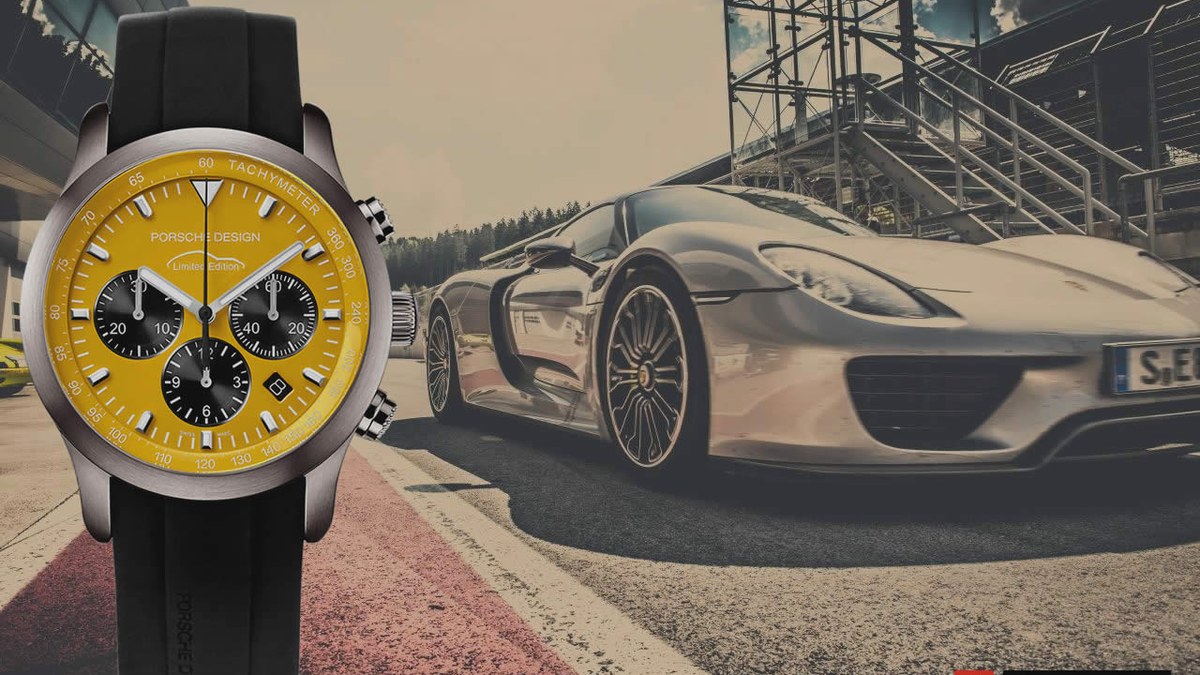
Porsche Design is a genuine ETA case study
Porsche Design has genuinely used ETA-family chronograph movements, making the brand one of the clearest historical examples for checking a Swiss ETA claim. Porsche Design’s own Chronotimer Series 1 documentation lists an ETA-Valjoux 7750 automatic chronograph inside a titanium watch. Porsche Design Chronotimer Series 1.
That makes this page different from the Omega or Cartier pages. Here, an ETA 7750 is not merely a convenient substitute; it can be historically consistent with a genuine Porsche Design reference.
The design story begins in 1972
Porsche Design traces its watchmaking identity to the Chronograph I, created by Ferdinand Alexander Porsche in 1972. The brand describes it as the first matt-black chronograph and directly connects its high-contrast dial to Porsche cockpit instrumentation. Porsche Design heritage.
That history matters to replica evaluation because the watch is fundamentally about restrained instrument design. Black coating, matte surfaces, typography and legibility matter as much as the movement name. A glossy case or poorly weighted dial can miss the point even if the chronograph works correctly.
7750 architecture shapes the case
The ETA 7750 is 7.90 mm high, so authentic 7750-based Porsche Design chronographs have real mechanical depth. A replica that looks unnaturally thin may be using a different movement; one that is too thick may be stacking an additional module or using a generic case. Side photographs are essential.
Check pusher height, crown alignment, caseback projection and rotor behaviour together. One clue rarely proves anything; several consistent clues create a credible movement story.
Modern Porsche Design is no longer an ETA-only story
Today Porsche Design develops and manufactures watches through its own watchmaking operation in Solothurn and uses Porsche Design calibres such as WERK 01.100 in custom-built chronographs. Porsche Design custom-built timepieces.
So a replica listing that says “Porsche Design = ETA 7750” needs a date attached to the claim. It can be historically correct for certain models and incorrect as a blanket description of the modern brand.
Porsche Design QC priorities
- Identify the exact historical or modern Porsche Design reference.
- Check case material and coating—titanium and black coatings have distinct texture and weight.
- Verify chronograph subdial layout and pusher function.
- Compare dial typography and high-contrast readability with the reference.
- For an ETA claim, inspect the actual movement and compare it with published 7750 geometry.
- Do not assume COSC status, water resistance or Swiss Made origin from movement branding alone.
Material claims are central to Porsche Design replicas
Porsche Design has long used titanium and dark surface treatments to support the instrument-like aesthetic. Weight and surface texture therefore matter more here than on a generic steel chronograph. A seller who claims titanium should be able to provide a plausible total weight or material specification. Colour alone is not enough because steel can be bead-blasted or coated to imitate titanium visually.
Inspect edges where coatings tend to thin, especially around clasp contact points, crown guards and pusher openings. A new watch can look convincing from the front while revealing a cheaper coating system from the side.
Chronograph I design is simpler than it looks to copy
The basic recipe—black case, black dial, white markings and a red accent—appears straightforward. In practice, the success of the design depends on proportion and readability. Hand lengths, subdial contrast, tachymeter scale, case finish and typography all need to remain disciplined. An overly glossy dial or thick white printing can make the watch look less like an instrument and more like a fashion chronograph.
That is one reason movement-only comparisons are incomplete. Movement choice can be historically relevant, but the exterior design language is what makes the watch Porsche Design.
Historical accuracy needs a model number
Porsche Design has used different movement suppliers and later developed its own WERK calibres. Therefore “Porsche Design uses ETA” is only meaningful when tied to a reference or era. When buying a replica, ask which genuine model it is copying and then research that model’s movement, case material and dimensions. A historically correct movement for one Porsche Design watch may be wrong for another.
Use the dashboard idea as an editing test
Porsche Design repeatedly describes its watches through function, legibility and automotive instrumentation. That gives buyers an unusually clear way to judge a replica: every decorative choice should support readability. If the dial has oversized branding, overly bright polishing or crowded text that competes with the time display, the watch is moving away from the design philosophy even if the basic silhouette is correct.
The same applies to the chronograph. Pushers should feel like controls, not ornamental buttons. Registers should be easy to read, and the red timing accents should have a functional relationship to the display. These qualitative checks are not as easy to reduce to a number as movement frequency, but they are central to whether the watch actually feels like Porsche Design.
For older 7750-based references, use movement architecture as one layer of evidence. For modern references, research the specific WERK calibre and do not assume historical ETA use continues unchanged.