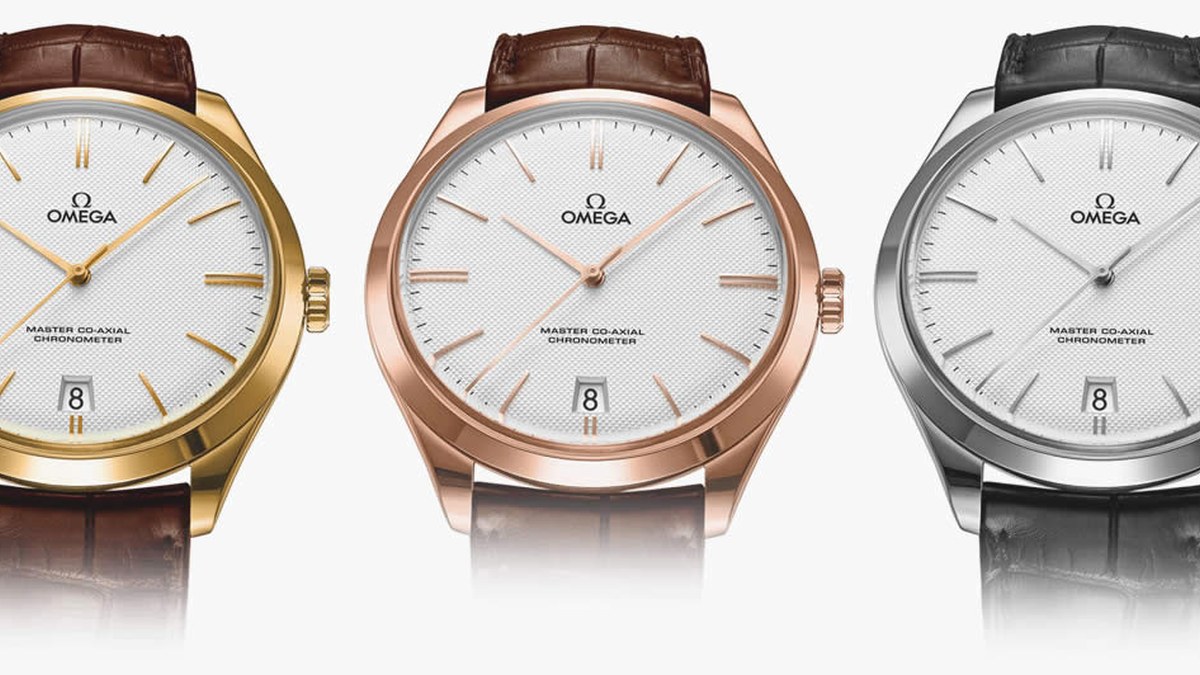
De Ville needs a modern movement baseline
Replica discussions often treat an ETA movement as the natural high-end choice for the Omega De Ville Trésor. That shortcut no longer describes the current genuine reference. Modern De Ville Prestige models use Omega Co-Axial Master Chronometer calibres such as 8800, while current Trésor references use Omega calibres such as the hand-wound 8926. Omega De Ville Prestige 8800 and Omega Trésor 8926.
That means an ETA-powered De Ville replica should be judged as an alternative mechanical solution, not as a clone of the current Omega movement.
The Trésor is a proportion test before it is a movement test
Current Trésor examples are defined by a thin, restrained case and clean dial architecture. Omega lists a 40 mm steel Trésor with calibre 8926 at roughly 10.05 mm thick, with small seconds at six and a 72-hour reserve. A replica using a thicker automatic calibre may change crown height, caseback depth and dial spacing even if the front photograph initially looks convincing.
For this model, compare side profile, lug-to-lug length, small-seconds placement and the relationship between the dial and bezel before worrying about movement decoration.
Prestige and Trésor should not be mixed together
The De Ville name contains different families. Prestige is generally an automatic dress-watch line, while modern Trésor references include hand-wound executions. A seller who calls every De Ville “Trésor” or every Omega automatic “ETA” is collapsing distinct products into one label. Ask for the exact reference the replica is intended to resemble.
What an ETA alternative can do well
A good ETA-family automatic can offer dependable timekeeping, familiar servicing and a clean date function. In a replica where the caseback is closed and the target reference has similar crown/date geometry, that may be a sensible compromise. What it cannot do is reproduce Omega’s current Co-Axial architecture, METAS certification or anti-magnetic specification simply by being Swiss.
METAS explains that Master Chronometer certification tests the complete finished watch against defined performance criteria; it is not a generic attribute inherited from a Swiss movement. METAS watch certification.
De Ville QC priorities
- Case diameter, thickness and lug length compared with the exact Omega reference.
- Small-seconds or central-seconds layout matches the chosen De Ville family.
- Dial printing is clean and aligned; dress watches expose small typographic errors.
- Crown height and caseback depth make sense for the movement inside.
- Movement claim is supported by a clear photograph rather than a seller label.
- Leather strap, buckle and polished surfaces are inspected for finishing defects.
Co-Axial language should never be copied onto an ETA movement
Omega’s Co-Axial escapement is part of Omega’s movement architecture. A conventional ETA 2824 or 2892 does not become Co-Axial because it is placed inside an Omega-style case or because the dial contains “Co-Axial” text. The label on the replica reproduces the appearance of the genuine dial; it does not describe the internal escapement unless the movement actually supports that claim.
This is particularly important with current De Ville Prestige and Trésor models because Omega also emphasizes METAS Master Chronometer testing on many references. Those certifications apply to qualifying genuine watches that pass the defined test regime. A replica should be judged using its own measured timing, magnetic resistance only if tested, and its own water-resistance test.
Dial texture and small seconds deserve close inspection
De Ville watches are quiet designs. The domed dial, applied markers and small-seconds register on some Trésor references leave little room for poor printing. Ask for a photograph taken perpendicular to the dial under diffuse light. Check that the small-seconds register is centred, the hand reaches the scale correctly and the logo/wordmark is level.
If the replica uses a different movement, the subdial may need to be relocated or driven through an added module. A position that is only one or two millimetres off can be obvious once compared with the correct reference.
Caseback choice changes what movement accuracy means
A display caseback invites comparison with Omega’s highly finished genuine calibre, so a generic ETA can look mechanically unrelated even if it runs well. A closed caseback shifts the value calculation toward reliability, thinness and function. Decide whether movement appearance matters before paying for decoration that you may rarely see.
Select the genuine reference before judging the replica
De Ville is not one watch. Prestige, Trésor and older De Ville generations differ in case size, seconds display, date placement and movement type. A seller may reuse the same stock description across several watches, so the buyer should identify the closest genuine reference from the dial, case and hands before comparing specifications.
For a modern Trésor with small seconds, the position and diameter of the six-o’clock register should be measured visually against the genuine model. For a Prestige automatic, central seconds and the date window become more important. If the replica combines features from two different genuine references, no movement upgrade can make the result reference-correct.
Also check whether the caseback is open or closed. Modern Omega display backs make movement appearance part of the design; a generic ETA may be a good timekeeper while looking unrelated. If that difference matters to you, treat it as a visible compromise rather than a hidden technical detail.